

From Possible to Actionable in Engineering Diplomacy
How a teenager’s idea became a $12.7M resilience plan

When he was 13, Ramon Rodriguez stood up in front of the Presidio City Council and asked for something that sounded out of reach for a small, arid border town: a department to protect the environment; greenhouses and tree nurseries that would capture scarce water; dedicated green spaces that development couldn’t swallow. The Presidio City Council stretched thin on a shoestring budget didn’t adopt his proposal.
The idea didn’t die. Rodriguez kept showing up.
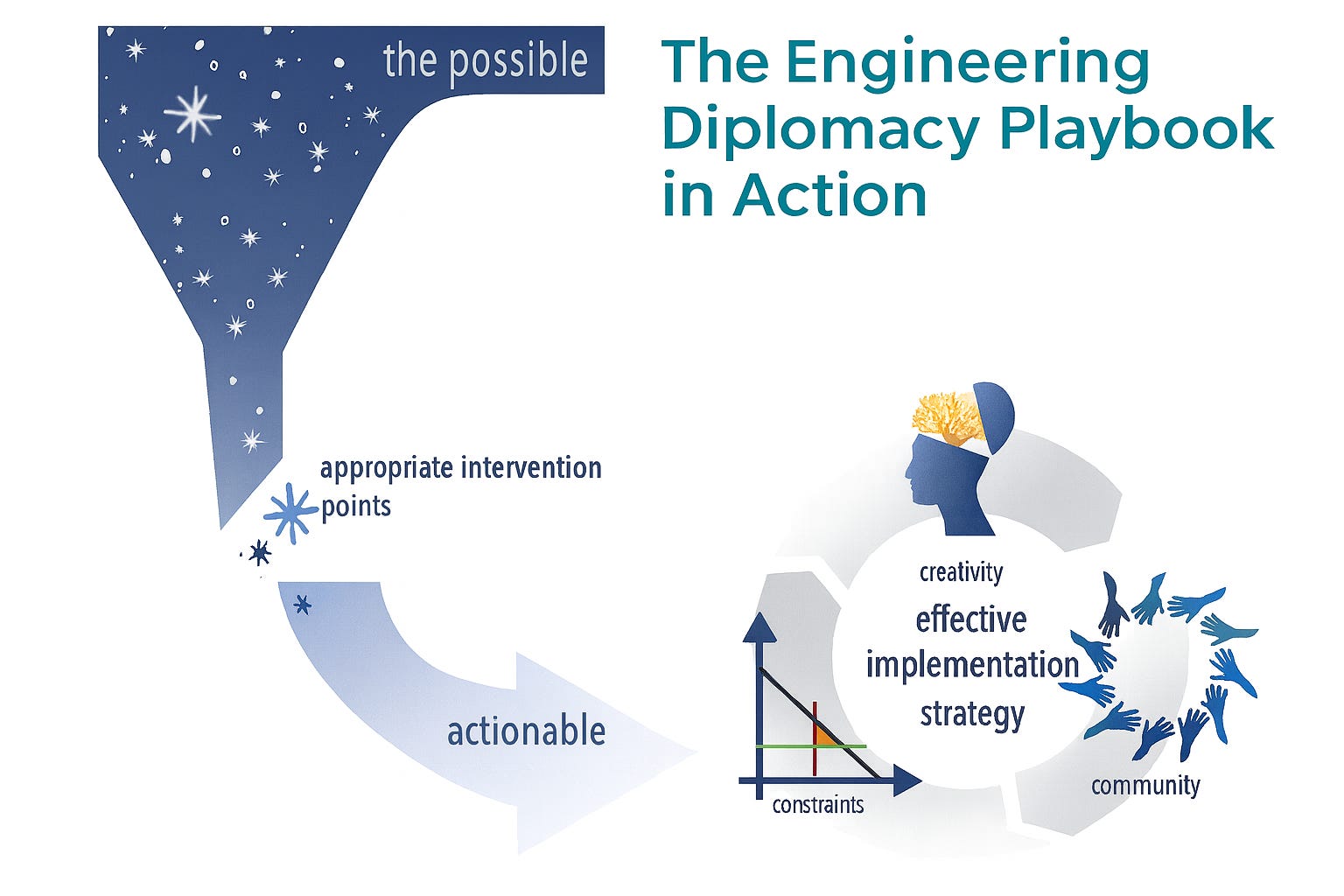
Six years later, in 2024, Presidio and the Big Bend Conservation Alliance secured a $12.7 million EPA grant for Everything Is Connected in Presidio, Texas, United States. The project combines green infrastructure and nature-based solutions with practical protections for residents: heat mitigation, flood management, pollution reduction, and a cooling center for emergencies. Rodriguez’s early vision—we need this, we should have this—now had a financing plan, an institutional home, and a path to delivery.
Presidio isn’t a city with abundant resources. With roughly 3,000 residents, it relies on property taxes and a regional landfill to generate about $4 million a year—money that has to cover municipal, police and emergency services. Parts of town still lack sewer lines. “We function a lot like a colonia,” the mayor has said—impoverished border communities with thin municipal infrastructure. And still, the coalition found a way to turn a teenager’s “possible” dream into a community’s “actionable” agenda.
What Engineering Diplomacy sees in this story
Is this Engineering Diplomacy Playbook in action?
A local voice meets institutional muscle. The spark came from a youth leader, but momentum came when the city and an established nonprofit aligned the idea with a funding window and an actionable scope. A credible plan, legitimate partners, and actionable steps consistent with capacity and constraints.
Design meets delivery. The proposal didn’t rest on abstract climate resilience language. It translated problems into near-term, felt benefits: create cooler places to gather and help the community’s most vulnerable residents, design detention ponds to capture water, use solar power to run the activity center, plant trees to create shade throughout residential neighborhoods that connect to the schools, services, and recreational areas.
Learn by doing. Bureaucracy didn’t disappear; the team moved anyway—sequencing permits, lining up matches, adjusting timelines. Actionability creates momentum, and transparency builds trust.
Equity is not an add-on. In a town with a limited tax base and patchy infrastructure, investments need to serve those most exposed to risks. This social awareness shaped technical choices that are implementable and sustainable.
A Playbook for other communities
If you want to experiment with “learning by doing” where you live:
· Diagnose a shared pain. Heat islands around the city center. Chronic street flooding around a clinic. Describe the problem in one sentence that residents recognize.
· Draw the “problem shed.” Don’t fight over jurisdiction—draw the box big enough to include all affected by the pain.
· Explore a visible set of actionable solutions. For example, pair a nature-based fix (trees, detention ponds), a monitoring node (low-cost sensors, community data), and a relief shelter (a cooling room with backup power). These actionable solutions with visible benefits make ideas fundable.
· Publicize Outcomes. Track a few metrics people can see: shade/trees added, number of homes protected from flooding, and days the cooling center was used.
· Co-own delivery. City, school district, church, clinic, small businesses—spread ownership so the project survives budget uncertainty and election cycles.
· Expect some misses. Actionability requires transparency and humility. Not every intervention will work as planned; learn, adapt, and show resilience.
Why it worked in Presidio, Texas
Problem-space clarity. The coalition didn’t chase everything at once. They picked extreme heat, flooding, and pollution—risks residents were already living with—and set out to reduce exposure first.
Institutional allies. A respected NGO partnered with the city so the project had both community roots and administrative capacity.
Program fit. The vision aligned with a federal program designed to fund exactly this kind of work; the application told a numbers and narrative story that resonated with actionability.
Trust built in public. The message was consistent: we’re building this together—watch us measure and adapt as we go.
The Engineering Diplomacy takeaway
This is what principled pragmatism looks like in practice. Recall the Blob in a Box. Co-ownership, actionability, and transparency defined the box in Presidio. Inside the box, the blob is the co-created solutions where decisions adapt to capacity and constraints.
The outcome isn’t a grant; it’s a working coalition that created desirable outcomes and will survive after the ribbon-cutting,
Have you seen an apparently outrageous idea turned into a transformative project—or watched a brilliant idea stall because it skipped the diagnosis of the problem-space? Recall Schoen’s Breaktime Story: Breaking the Cycle of Young Adult Homelessness in Boston.
Share your story. What was the hinge that made it actionable—or the miss that kept it from moving?