

Is There a Difference Between Science and Scientific Method
Why and How it Matters for Decision-Making

Physics is not psychology.
Psychology is not political science.
Yet these three disciplines claim to be science.
In what ways are they similar or different? Why and how it matters?
Science is a systematic approach to discovering how “things” in the universe work. It is a library of knowledge accumulated through the discoveries about different things. The word “science” was derived from the Latin word “scientia,” which means knowledge.
What is knowledge? How do we know what we know?
These are important questions that have kept philosophers, scientists, and academics busy for centuries. We are not addressing these questions here. Instead, we are interested in a class of problems popularly known as collective action problems. We are problem-focused and process-aware. We want a process to agree on what we know and how we know it. With that knowledge, what can we do to solve the problems we face?
How Physics, Psychology, and Political Science Use Scientific Methods
We view science as the evolving library of reliable claim while scientific method is the shared process and tools (hypothesis, observation, testing, replication, peer scrutiny) different disciplines use to add or remove claims from that library. Around 17th century science solidified its prominence by ensuring observable, reproducible, falsifiable, and generalizable findings through measuring, testing, and analyzing, a process known as the scientific method. Yet distinguishing among physics, psychology, and political science in terms of applying scientific methods remains a contentious task. Here is why.
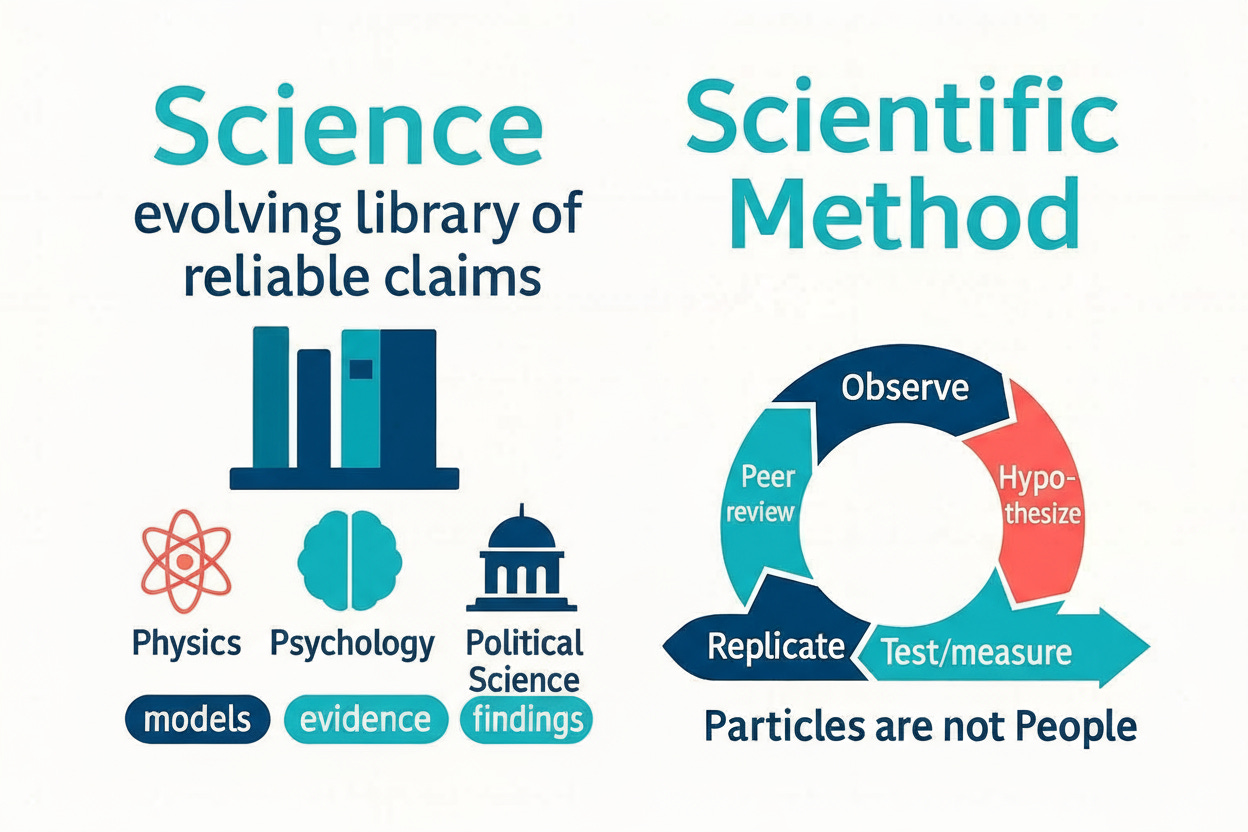
Physics: Physics is often regarded as a rigorous scientific discipline. It emphasizes the application of precise mathematical models, experimental design, and quantitative measurements. Physics experiments often involve controlled conditions, rigorous data analysis, and the ability to make precise predictions based on “particles”. The principles of observability, replicability, falsifiability, and generalizability are strongly emphasized in physics.
Psychology: As a science, psychology faces some unique challenges compared to physics because it studies “people” not “particles”. While psychology research employs rigorous methodologies such as experimental designs, surveys, and statistical analyses, there are inherent difficulties in controlling variables and replicating studies due to the inherent variability and intentionality of human behavior. Consequently, the principles of observability, replicability, falsifiability, and generalizability can’t be applied as rigorously in psychology as in physics.
Political Science: Political science, as a social science, faces different set of challenges in terms of applying the rigor of scientific methods. The study of political systems, institutions, and behavior involves complex and dynamic phenomena influenced by social, cultural, and historical factors. Observability can be more challenging in political science compared to physics, as political phenomena are not always directly observable and often require the use of surveys, interviews, or archival data. Replicability can also be challenging due to variations in political contexts and the difficulty of conducting controlled experiments.
The rigor of scientific method is pursued differently in different disciplines because of the unit of analysis and characteristics of the subject matter (particle or people) and the type of research questions being addressed. Each discipline has its own unique challenges and opportunities for applying scientific methods depending on how tightly they can control confounders and by the stability of the systems (particle, people, or both) they study, which changes how strongly each norm (observability, replicability, falsifiability) can be applied.
Scientific facts, as I define here - are measurable, reproducible, falsifiable, and generalizable - not opinions, feelings, or preferences. What I want to emphasize is that use of scientific facts in decision-making is not an attempt to define “the truth” but to agree on “a truth”. More importantly, scientific facts are always contingent and subject to revision as new observations become available. Recall, before Copernicus, the prevailing view was that the sun orbited the earth. Earth orbits the sun gained traction with new observations made by Copernicus, Kepler, and Galileo. Social facts, on the other hand, are collectively held beliefs, rules, norms, and institutions that shape behavior and decisions, and which are interpretational and often context-dependent.
A focus on objectivity of scientific facts serves us well when we work with well-structured problems. If we assume that water is a “thing or object or particle” consisting of hydrogen and oxygen. Then, physics like rigor of scientific methods is applicable and we can design and implement solutions using scientific facts – that are measurable, replicable, and falsifiable - as our guiding principle. This class of problems is well-structured, and their dynamics are autonomous, not intentional. We can (and will) continue to improve our methods, processes, and protocols to make significant advances in addressing this class of problems we call simple and complicated.
Advancement in addressing the above class of problems, however, most likely will not translate well to address problems that are coupled where physical and societal variables, processes, actors, and institutions are entangled. As an example, for this class of problems, water is not a “thing or object or particle” but water is a “resource that is used for a purpose” where it can defy gravity and flow uphill to money. This class of problems is rooted in contexts, values, and intentions and is dominated by interpretations, perceptions, and biases. These problems can’t be understood using the scientific methods as objectively as we can do with particles.
What approach do we need to address the complexity of these problems where particles and people are coupled. Our focus is on actionability: What can we do with what we know. We are not looking to define ‘the truth’ but to agree on a negotiated understanding of ‘a truth’ that is actionable given the capacity and constraints within a given problem-context. To sum, the power and pragmatism of such an approach is not on replicability or generalizability but on arriving at a consensus of implementability by remaining focused on desirable outcomes.
Climate Change: A Case Study Across Disciplines
Climate change is a textbook example of a collective action problem that illustrates how science and the scientific method play out in real life. The statement “climate change is real and caused by humans” is a scientific fact, supported by decades of research. Through the painstaking application of the scientific method across many fields, especially physics, chemistry, and earth science. Scientists observed phenomena (e.g. rising global temperatures, retreating glaciers), formed hypotheses (say, “Increasing CO₂ in the atmosphere is trapping more heat”), collected data (from ice cores, weather stations, satellites, ocean buoys), and analyzed the results. The evidence for warming piled up, from multiple independent lines of investigation. For instance, starting in the late 1950s, continuous CO₂ measurements in Hawaii revealed a steady year-by-year rise in atmospheric carbon dioxide. By testing and retesting such findings, the scientific community built a robust scientific fact: human activities are extremely likely the dominant cause of recent global warming. Hundreds of peer-reviewed studies, climate model experiments, and empirical observations all converged on this scientific fact. In science-speak, the hypothesis of human-caused warming has withstood repeated attempts to falsify it, and instead the evidence keeps affirming it. In short, climate science did exactly what science is supposed to do: focus on evidence, test hypotheses (e.g. “is it the sun causing warming?” – tests showed no, the sun’s output hasn’t increased), and rule out alternate explanations until the best explanation remaining is the one supported by data (in this case, greenhouse gases warming the planet).
Yet, debates around climate change also illustrates the limits of scientific facts alone. The scientific method provided scientific facts, but acting on that fact is a human challenge. Here’s where psychology and political science enter the picture. For example, psychologists study why some people ignore or deny scientific evidence on climate change. It turns out that scientific facts don’t automatically convince everyone – our values, identities, and cognitive biases filter how we interpret these facts. Research shows that factors like political identity can strongly influence one’s acceptance of scientific facts related to climate change. This isn’t because these climate skeptics uncovered a flaw in physics, but often because accepting climate change’s implications conflicts with their worldview or economic interests (a phenomenon researchers call motivated reasoning or identity-protective cognition). Psychologists and social scientists have identified various mental barriers: people may downplay climate risks because the worst effects seem distant or abstract, or they may align with their community’s stance to maintain social cohesion. It’s a reminder that simply presenting scientific fact as evidence (though necessary) might not be sufficient to spur action – messaging has to connect with values and address anxieties, which is something behavioral science can inform.
Meanwhile, political science examines how societies respond to scientific facts related to climate change. What policies get enacted (or blocked), and why? Political scientists use the tools of their field to analyze international climate negotiations, national policies, and the role of interest groups. They might ask, for instance, “What political conditions lead countries to adopt strong climate policies?” or “Do democracies perform better than authoritarian regimes in reducing emissions?” Using historical data and case comparisons, they try to tease out patterns. They also study the influence of misinformation campaigns (for example, fossil fuel industry lobbying) on public opinion and policy – essentially tracking how scientific facts get translated (or impeded) in the political arena. Political science research has shown that scientific facts alone doesn’t guarantee political action; factors like public opinion, economic interests, and institutional structures matter hugely. For example, despite the scientific consensus on climate change, policies differ widely across countries – partly due to political ideologies and stakeholder pressures. Understanding those dynamics is key to crafting solutions. It’s one thing for climate scientists to model how to limit warming to 1.5°C, but implementing those solutions requires navigating governance, economics, and human behavior.
Engineering Diplomacy synthesizes credible scientific facts with legitimate social facts to design and implement feasible actions for desirable outcomes,
The scientific method is our ‘gold standard for self-correction’ for minimizing bias, testing ideas against reality, and self-correcting over time. Physics, psychology, and political science may study vastly different puzzles – from subatomic particles to human behavior to government systems – but all share a commitment to self-correction based on new evidence. Appreciating the difference between science (the knowledge we acquire) and the scientific method (how we acquire that knowledge) matters for everyone. It helps us be informed citizens who can tell the difference between an evidence-backed scientific facts and interpretational ambiguity of social facts.
In the context of climate change, this understanding is empowering. We don’t have to feel that climate science is a mysterious oracle; we can recognize it as the cumulative result of many tests, observations, and corrections over decades. Likewise, when we encounter debates or skepticism, we can ask: Are these arguments following the scientific method? Are they based on evidence and open to revision, or on rhetoric and cherry-picked data? Often, the loudest climate skeptics violate the norms of the scientific method – ignoring the body of evidence or moving the goalposts when one claim is debunked. In short, “following the science” as a pragmatic tool means following the evidence and being willing to change course if evidence demands – exactly what the scientific method teaches us.
For engineer-diplomats and society at large, embracing the scientific method’s mindset can be deeply beneficial. It encourages critical thinking, skepticism of baseless claims, and openness to new information. It’s what allows science to inform policy sensibly – whether it’s public health, environmental protection, ethical use of AI, or cybersecurity. To circle back to our opening analogy: the library of science is always growing and occasionally rewriting itself, and we are all patrons who can learn how to discern a well-researched finding from a dubious one. Different disciplines may speak in different jargon or deal with different levels of uncertainty, but they are ultimately chapters of the same grand story – the human quest to understand our world through evidence and reason. And when it comes to challenges like climate change, it’s a story we’re writing together, by synthesizing scientific and social facts to ensure it has a hopeful next chapter. This is where Engineering Diplomacy operates: synthesize scientific facts with social facts to design actions that are feasible, desirable and sustainable.
The early months of COVID made the difference between science and the scientific method painfully visible. Masks seemed to work—then they didn’t—then did again as evidence clarified that indoor exposure increases risk of transmission and infection. For the public it felt like whiplash; for science it was routine self-correction with new information. An Engineering Diplomacy lens would have framed the problem space up differently—reduce indoor transmission and exposure while preserving learning by doing and ensuring livelihoods. Then implement adaptive moves tied to public triggers: target high-risk settings first; set simple ventilation targets; shift activities outdoors when feasible; protect the most vulnerable; adjust as new evidence comes in. Fewer blanket rules, more societally acceptable actions for desirable outcomes.
Call to action: For your next policy or program decision for a problem, run a “method + context” huddle. Start with scientific facts and their uncertainties; discuss and understand social facts; agree on a problem statement and process (who decides what to do, how to do, and how to evaluate progress); Pick a first pilot with two or three trackable metrics to evaluate progress and agreed upon triggers for tightening or easing.
Diagnose, define, implement, measure, evaluate, and adapt. I would love to hear your examples for call to action to build our library of learned experience.