

Making Room for Rivers
Engineering Diplomacy Lessons from the Netherlands

In 1995, the Netherlands nearly drowned in its own success.
Decades of holding back the Rhine and Meuse behind towering dikes had kept the country dry - until a supercharged rainstorm forced the evacuation of 250,000 people.
A natural hazard did not become a societal disaster.
No dikes broke, but the wake-up call was clear: fighting water was no longer enough. A new strategy was born instead of fighting the river, work with the river.
From 2006 to 2015, the Dutch government undertook an ambitious €2.3 billion program called Room for the River to rewrite the country’s flood protection playbook. The core idea was simple: make space for floodwaters in a controlled way, before they make themselves at home in our living rooms. In practical terms, this meant moving dikes inland, digging new side channels, lowering floodplains, and even eliminating some polders (letting former reclaimed land periodically flood) to increase the capacity of the rivers. By the end of the program, roughly 30 engineering projects along the Rhine delta were completed, boosting the flood discharge capacity by about 10%.
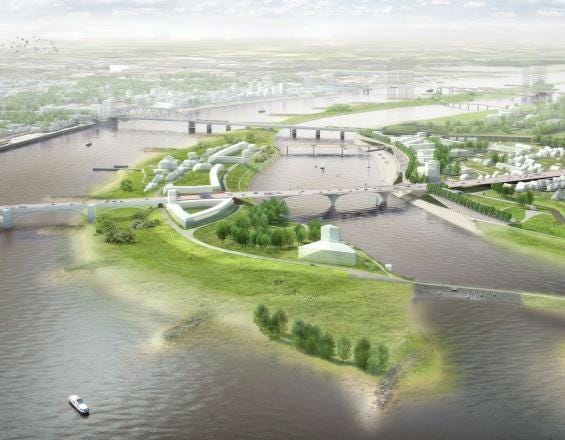
Image Credit: H+N+S Landscape architects
Equally important, the projects were designed to beautify and enrich the river landscapes. This was not just flood control – it was a coordinated makeover of the Rhine’s environment, adding parks, restoring wetlands, and revitalizing riverside towns.
How did the Dutch pull this off, especially in a country where land is scarce and almost every square meter has an owner or a function? The answer lies in a blend of science, consensus-building, and creative actionability that turned a crisis into an opportunity. It’s a story of evidence-based policymaking done right, and it holds lessons for collective action problems like climate adaptation and infrastructure planning everywhere.
From Dominance to Working with River
The shift in mindset that was behind Room for the River is striking. Historically, the Dutch relationship with water was all about domination – think of those iconic windmills pumping out polders or the giant sea barriers of the Delta Works. By the 1990s, however, two forces converged. First, nature issued a wake-up call (the floods of 1993 and 1995). Second, climate science began projecting even more extreme scenarios for the future. Hydrologists warned that peak flows in the Rhine could rise by 10–20% by 2050 due to heavier winter rains and quicker snowmelt upstream. A flow so high it would overwhelm the old levee system.
It was a bitter pill: the old approach simply would not be enough. As the Dutch Vice-Minister of Water Management at the time candidly told the public, “Sleeping safely behind dikes” was yesterday’s dream. The new reality is learning to live with water.
This new thinking translated into a few key actionable ideas for Room for the River. Safety first, but not safety alone. The projects had to lower flood risks and deliver other benefits – a dual objective of flood protection and environmental quality. Where a dike was set back from the river, the newly freed floodplain might become a nature reserve or a recreational area. If farmland had to be lowered, perhaps it could double as a wetland habitat. Every project was like a negotiation between the river’s needs and the people’s needs.
This shift in mindset was more than philosophical - it transformed how the Dutch gathered knowledge, built plans, and engaged with people, starting with scientific facts.
Scientific Facts: Know Your River
At the heart of the program was credible scientific studies. Dutch engineers and modelers basically ran a giant “what-if” simulation: what if we take this dike here and move it 300 meters inland? What if we dig a side channel around that pinch point? How many centimeters would that shave off the flood water level?” These models produced hard numbers that guided decisions. For example, at Nijmegen – a city where the Waal (Rhine’s branch) narrows dangerously – simulations showed that moving the dike and creating a bypass channel could lower extreme water levels by about 34 cm. That’s roughly a foot – which can make the difference between a close call and a calamity. The plan was duly implemented, and indeed in 2016 they measured about a 35 cm reduction, even better than expected. Similarly, dredging a “Green River” bypass in a rural stretch was calculated to drop flood crests downstream by ~30 cm, which was enough to meet safety standards.
Another fascinating science aspect was climate foresight. The Dutch weren’t solving yesterday’s problem; they were anticipating tomorrow’s world. Even though a flood of 16,000 m³/s hadn’t physically happened yet, they treated it as effectively inevitable in the long run and designed accordingly. This is a hallmark of adaptive planning. They also built flexibility into designs. For instance, some projects include areas that could be excavated further in the future if needed. All this stems from an acceptance that our understanding is never perfect – an engineering diplomacy core idea of fallibilism in decision-making. If new research in 10 years says “We need even more room,” the Dutch plan to adjust course. That kind of humility in policy (“we think this is best, but we might be wrong and will adapt if so”) is refreshing and, frankly, prudent in the face of uncertainty.
Social Facts: Work with River and People
Grand plans fail not from lack of scientific facts but from human pushback because of societal norms and values. The Dutch understood this. Room for the River didn’t just engineer space for water, it created space for trust. Instead of pushing a top-down blueprint, the program empowered local stakeholders: municipal leaders, farmers, NGOs, and residents to help shape each solution. The national office set measurable goals (e.g. lower the flood level here by 30 cm); locals decided how to get there.
That co-ownership paid off. In Nijmegen, a feared demolition plan became a community win when residents co-designed a new riverfront district, an island with parks, bridges, and housing. As Mayor Hubert Bruls said, “We turned a danger into an opportunity.” In the Noordwaard polder, the challenge was convincing farmers to let their land flood. Those who wanted to leave were compensated generously. Those who stayed were offered mounds and raised infrastructure (like modern terps) to ride out future floods.
This wasn’t checkbox consultation. The government built visitors’ centers, ran simulations on smartphone apps, and hosted townhalls. People asked hard questions. Why here? What about my house? And got credible answers. By acknowledging concerns of affected communities, and giving real options, the program built consent without coercion.
The result was not uniform enthusiasm but achieved a critical threshold of legitimacy. And that mattered more. Because when people feel heard and when they believe they have a skin in the game, they’re more likely to live with it.
Metaphors to Meaning: Engineering Diplomacy in Action
Room for the River worked because it didn’t just chase one goal. It blended many. That creative fusion of ideas and active engagement unlocked creative leverage. Projects attracted broad alliances: city developers saw opportunity, environmentalists saw restoration, and flood engineers got their safety targets met. At every level, from municipalities to Parliament, Room for the River was hard to oppose because it delivered values for many that are scientifically credible, socially acceptable and politically feasible.
The Room for the River story illustrates three powerful metaphors from the Engineering Diplomacy Framework. First, “1 + 1 > 2”: scientific facts paired with local knowledge produced smarter, more actionable solutions than either alone, for example, in Nijmegen, where co-creating the river island yielded both safety and community space. Second, “Where is X?”: the program succeeded because it asked the right question. Not just how to block floods, but how to live with water. That reframing unlocked entirely new strategies. And third, “where is the 18th Camel”: seemingly incompatible goals—safety, ecology, urban growth—were not traded off but synthesized for actionable outcomes. A flood bypass became a park, a wetland, a neighborhood. These metaphors weren’t just ideas; they shaped action on the ground.
Results and Reflections
By 2017, the rivers had more room, the country had more safety, and dozens of riverfronts had been transformed. The 16,000 m³/s discharge goal was met. Nijmegen’s river park is now a vibrant urban common. And the program came in on time and on budget. No small feat for infrastructure on this scale.
But the deeper legacy is influence. The Dutch baked these lessons into their national Delta Program. Other countries—from the UK to the US—have followed with their own “Room for Water” projects. The Dutch didn’t just solve a problem. They created a mindset and an actionable plant that is transferrable and implementable elsewhere.
Start with your own landscape. Where have rigid systems failed? Where has water been boxed in, and where have plans ignored the people living there? Share where you’ve made space—not just for nature to return, but for communities to thrive alongside it.
In Bangladesh, many flood control projects have been built since 1960s. Main features of these projects are embankments along the main rivers and gated structures at the mouth of internal connecting rivers. Such interventions kept the protected areas flood free but, in the process, disconnected and killed the internal rivers. These rivers were gradually encroached, filled up and became heavily polluted in absence of any natural flow. Many protected areas now greatly suffer from uninhabitable conditions.
At many places, there have been vigorous public protests against inhuman living conditions and people have started demanding revival of the dead rivers by removing the gates on the rivers ensuring free flow of water once again. One such river is Ichamoti river in the north-west region of Bangladesh. The implementing agency, Bangladesh Water Development Board entrusted the Institute of Water and Flood Management, Bangladesh University of Engineering and Technology to carry out a feasibility study of resuscitation of the river. As part of the study team, we engaged with the local people from the beginning of the study to co-create a vision for the revived river. We accordingly planned and co-designed a riverfront consisting of parks, walking and boating facilities along the river bank in urban areas keeping remaining parts of the river in a natural state.
At the very early stage of the exercise, we tried to find out the importance of the flowing river to the local people. We found that the river is culturally important to the local people as our famous poet Rabindranath Tagore wrote a very popular poem about it. Ecologically it is also very important as it connects two mighty rivers, the Ganges and the Brahmaputra and receives flood flow from both rivers. We could not find example of any such river anywhere in the world and sold this ecological importance for the revival of the river among the stakeholders. Such findings made it easier for us to carry out the study and can be compared to the ‘18th camel’ referred in the above article.
Rezaur Rahman
Former professor
IWFM, BUET
Thank you for this powerful and deeply resonant reflection. Your experience with the Ichamoti River offers a poignant mirror to many of the dilemmas Room for the River sought to address—but under very different historical and hydrological conditions. The unnticipated consequences you describe—disconnection, ecological degradation, and loss of cultural memory—highlight how narrowly conceived engineered solutions, even when successful in their technical aims, can hollow out the systems they intend to protect.
What stood out most is how your team’s approach embodies the very spirit of engineering diplomacy—especially the ‘18th camel’ metaphor. You didn’t just identify a technical fix; you co-created meaning, blending hydrological function with cultural memory and ecological value. The way you wove in Tagore’s poem as both a narrative anchor and a legitimacy builder is a brilliant example of how evidence can be broadened to include stories, identities, and aspirations.
I would love to learn more about your process. Would you be open to co-developing a Substack post focused on the lessons from the Ichamoti River? We could explore themes like:
How public memory and poetry became part of the planning toolkit
What it took to reframe a “dead river” into a shared vision for the future
Practical takeaways for other regions facing the consequences of gated, disconnected river systems
Your story deserves a wider audience. Let’s make room for that conversation.