

When Scientific Facts Lose Steam
Turning Concerns into Action Through Engineering Diplomacy

On July 4, 2025, central Texas was hit by a torrential storm. In just a few hours, up to 20 inches of rain fell across Hill Country. The Guadalupe River surged 26 feet in 45 minutes, sweeping away cabins at summer camps and killing more than 135 people, including dozens of children.
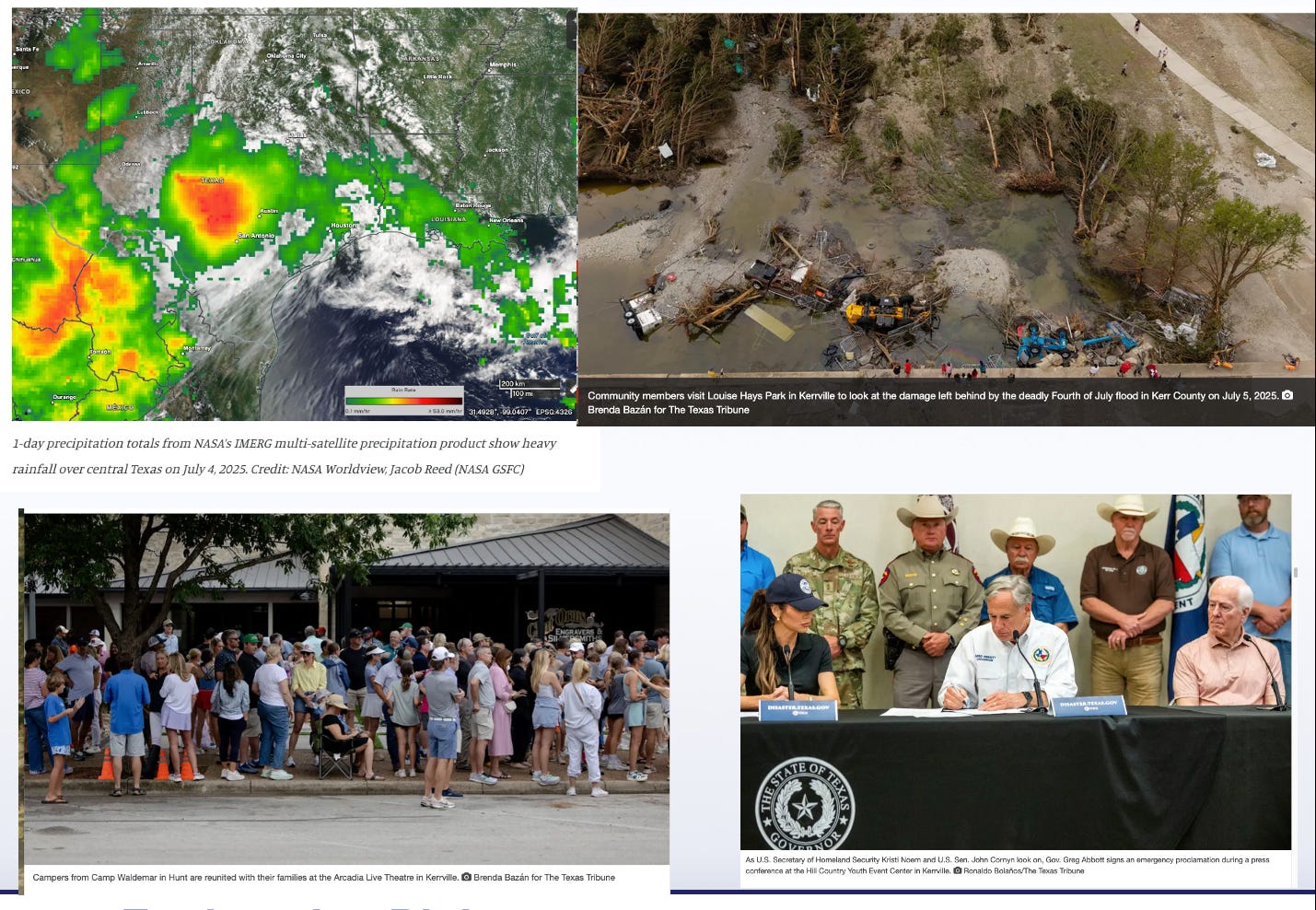
The science worked. The National Weather Service issued multiple warnings. Radar tracked the rainfall. Gauges measured the river’s rapid rise. Yet the tragedy unfolded anyway. Sirens were never activated. Evacuation plans didn’t exist. Residents slept through the danger.
Was this a “natural” hazard or a disaster? It was a clear case of natural hazard. The rainfall was extraordinary. But in another, more consequential way, the resulting disaster was not natural. It was the result of collective choices: years of underinvestment in warning systems, institutional inertia, and the failure to connect scientific knowledge with public action.
This is exactly the kind of crisis the Engineering Diplomacy Framework (EDF) is designed to address so that natural hazard does not become a societal disaster.
Why Scientific Facts Alone Lose Steam
Latour once asked: Why has critique run out of steam? He answered that scientific facts alone lose steam when they are treated as self-sufficient. No matter how solid, scientific facts rarely compel collective action on their own. They arrive wrapped in uncertainty, ambiguity, trade-offs, and values. If those concerns are ignored, the scientific facts don’t translate into action.
That’s exactly what happened in Texas. The meteorological science was sound; the radar captured the rainfall, the gauges tracked the river’s rise, and the warnings went out. But those scientific facts collided with matters of concern: cost objections, cultural resistance to sirens, and competing priorities in local government. In other words, Latour’s matters of concern look very much like what we call social facts: the norms, beliefs, and political choices that shape how scientific facts are received and acted upon.
The lesson is clear: scientific facts alone cannot drive action unless they are assembled with social facts. And that is precisely what EDF is designed to do. EDF synthesizes the two: taking scientific facts (observable, testable, provisional knowledge) and combining them with social facts (collective beliefs, norms, political dynamics) to co-produce outcomes that are scientifically credible, socially legitimate, and politically feasible.
Imagine a Future Together
Sheila Jasanoff reminds us that societies don’t just use science and technology—they imagine futures with them. She calls these sociotechnical imaginaries: collective visions of how life should be organized, made possible through science and technology.
In Texas, these imaginaries clashed. Local officials imagined their county as a quiet, self-reliant place where the “peace and quiet” mattered more than sirens in the night. Many residents imagined floods as rare events that could be managed with neighborly phone calls, the way they had done for decades. Scientists, by contrast, imagined a future safeguarded by high-tech networks of gauges, alerts, and evacuation drills.
The tragedy was that these imaginaries never converged. Until communities, policymakers, and scientists share a vision of living safely with floods, where modern warning systems are as needed and accepted as fire alarms, warning sirens will continue to sound like noise instead of trusted guidance.
EDF steps into this gap by creating a space where competing imaginaries are discussed, debated, and synthesized. It recognizes that durable solutions emerge not when one vision dominates, but when scientific facts and social facts are woven together into a shared future people can act on.
Engineering Diplomacy Fuses Imagined Future with Actionable Ideas
This is where Engineering Diplomacy makes the leap from philosophy to practice. EDF is about turning facts and concerns, hopes and fears, into solutions that are: scientifically credible (the data hold up), socially legitimate (people trust and accept them), and politically feasible (leaders can and will act on them)
It does so by working with four stakeholder communities: the knowledge community (scientists and experts), the resource community (those who control infrastructure and funding), the decision-making community (authorities and policymakers), and the affected community (citizens and civil society)
Making EDF actionable means identifying what each of these communities can do—in the short term and the long term—while ensuring they work in concert, not in isolation.
Metaphors to Meanings: EDF in Action for Texas
EDF is guided by three metaphors that make its key ideas practical and actionable:
What is one plus one? Even simple facts need negotiation of meaning. In Texas, meteorologists knew rainfall totals and river rise rates. But those two facts weren’t translated into a clear, urgent message like: ‘The camp by the river will be under water within the hour.’ One plus one never equaled two because meaning was lost in translation. EDF insists that experts and communities negotiate what facts mean in practice so that data leads to action.
Where do we put the X? Small, strategic interventions can have outsized impacts. In Texas, the ‘X’ was the decision to fund and install a modern siren and gauge network. That single move—small in the scale of state budgets—could have saved dozens of lives. Instead, officials balked at the $1 million price tag, even letting a federal mitigation grant lapse. EDF spotlights these leverage points: the modest but strategic actions that can shift an entire system from vulnerability to safety.
How do we find the 18th camel? Sometimes, reframing or adding a new element unlocks a stuck problem. Texas leaders resisted federal aid out of local pride and budget politics, and state legislators blocked new funding. The 18th camel here could have been a state-managed resilience fund: locally controlled but supported at the state level, preserving autonomy while ensuring resources. EDF trains us to look for that extra element that makes the impossible solvable.
What Have We Learned from the Texas Flood
The science worked. Radar tracked the storm, gauges recorded the river’s rapid rise, and the National Weather Service issued multiple warnings. But here’s the catch: those facts never translated into action on the ground. Scientists might have said, ‘six inches of rain in two hours,’ but for a camp counselor, that didn’t mean much. What they needed to hear was, ‘The river will rise 20 feet in the next 90 minutes—move the kids to higher ground now.’ This is where the knowledge community fell short: the scientific facts were right, but the meaning wasn’t translated to those who needed it most.
For nearly a decade, Kerr County debated whether to invest in a $1 million siren system. They even had a federal hazard mitigation grant in hand, but let the application expire over ‘aesthetics and dollars, not science or safety.’ When the flood hit, there were no sirens, no backup alerts, and the phone tree that camps relied on was too slow for a midnight disaster. The irony? Rescue boats and helicopters had to be deployed after the fact at far greater cost. EDF reminds us that the most effective way to spend resources is before the crisis, not after.
Decision-makers froze when it mattered most. Despite the avalanche of warnings, Kerr County officials never activated CodeRED alerts or sirens. They worried about false alarms, liability, and upsetting the ‘peace and quiet’ of their rural community. At the state level, lawmakers had the chance to pass House Bill 13—a grant program to fund outdoor warning systems in high-risk counties—but they voted it down just weeks before the flood. Leadership is not about perfection; it’s about acting decisively when people’s lives are at stake. Here, indecision was deadly.
Ordinary Texans bore the brunt. Parents woke up to phone calls that their children’s camps had been swept away. Neighbors with boats and pickup trucks became first responders, rescuing families stranded on rooftops. In the aftermath, mothers organized petitions demanding that the state finally install a warning system. Communities that once resisted ‘government interference’ now demanded protection. EDF sees the affected community as the moral compass: the ones who feel the consequences most sharply and whose voices must shape the solutions.
Knowing is Not Doing
These are not new problems. We have known for decades that rivers can rise in minutes, storms can drown cities, and heat waves can kill quickly. Yet time and again, we fail to act. The next natural hazard is inevitable. We may not know precisely when or where it will strike—but whether it becomes a disaster depends on what we choose to do now.
The 2025 Texas flood was not just a tragedy; it was déjà vu. In 1987, ten teenagers died in a night-time flood on the same river, under strikingly similar conditions. Afterward, officials promised change: warning systems, updated safety standards, stronger regulations. But those lessons were never institutionalized—never embedded in licensing, enforced in regulations, or practiced in communities. When the rain returned nearly four decades later, so did the same fatal vulnerabilities.
And Texas is not alone. In New Orleans, everyone knew the levees were weak—until Hurricane Katrina made the warnings real in 2005. In New York, city leaders had long modeled the cost of a major storm surge—millions invested could save billions. Yet it took Hurricane Sandy in 2012 to force action, at a cost of over $50 billion. In Japan, the 2011 Tōhoku earthquake and tsunami overwhelmed sea walls designed for smaller events, even though experts had warned of a “monster quake.” In Europe, the 2021 German floods killed more than 180 people despite detailed flood maps and early warnings. Across South Asia, thousands still die each year when monsoon embankments fail, and evacuation plans stay on paper.
Use What We Know to Do What We Care About
These recurring tragedies remind us: scientific facts alone lose steam when they are not synthesized with social facts, political will, and community trust. We don’t lack rainfall data, seismic models, or floodplain maps. What we lack is the ability to turn knowledge into durable, enforceable, and trusted action.
This is exactly what the EDF seeks to address. It doesn’t promise to prevent every loss. With EDF, scientists and ordinary citizens would have had clearer, more informed discussions leading to a better mutual understanding and action that fits the context. With EDF, people and policymakers alike would understand the cost of ignoring the need for a siren system. With EDF, hundreds of innocents could have survived a preventable disaster.
The challenge now is to ensure that this lesson is not lost. By bringing scientific facts together with social facts, aligning competing imaginaries, and negotiating solutions across knowledge, resource, decision-making, and affected communities, EDF offers something actionable: a framework to turn what we know and what we care about into trackable, collective action.
So, the challenge is no longer just knowing but doing. The river will rise again. The next hurricane will come. The next wildfire will burn. The real question is not if, but what we will do, and how. Share your ideas for action. How can we ensure that when the next hazard strikes, it does not become another preventable societal tragedy?