

How Superforecasters Think and What the Engineer-Diplomat Can Learn
Five Actionable Insights From the Dragonfly View to the 18th Camel

In a world overflowing with failed predictions and fragile certainties, superforecasters stand out—not as mystics, but as humble, disciplined thinkers. At their core, they’re “optimistic skeptics”: people who believe we can think better about the future if we ask sharper questions, challenge our own assumptions, and stay open to updating our views. They don’t rely on crystal balls; they rely on methods like breaking complex problems into parts, assigning probabilities, and refining judgments as new evidence emerges. It’s not magic. It’s mindset.
This mindset is especially relevant for the engineer-diplomat: part scientist, part humanist, part pragmatic decision-maker. Superforecasting offers not just a method for prediction, but a broader philosophy for acting wisely amid uncertainty and ambiguity.
Superforecasting represents a different way of thinking about decision-making. Advocates argue that Tetlock’s work suggest individuals can dramatically improve predictive accuracy through training, feedback, and the right cognitive habits. It’s empowering: forecasting isn’t just for elite experts or intelligence agencies; it’s a learnable skill, like playing chess.
A neutral stance acknowledges that superforecasting techniques offer valuable tools especially for structured, well-scoped questions but suggests their impact may be limited outside specific domains. It recognizes the merits of probabilistic thinking, humility, and updating, but notes that many real-world problems are open to multiple framing and interpretations for reliable forecasting.
Critics argue that superforecasting’s track record is overstated or misapplied. They contend that beating chance on geopolitical trivia doesn’t equate to insight on deep structural issues like equitable distribution of resource or technological upheaval. Some see it as reductionist, quantifying the unquantifiable, and potentially blinding decision-makers to moral, cultural, or systemic dimensions that can’t be captured in a spreadsheet. In this view, superforecasting might show some short-term accuracy, but risks privileging surface-level precision over deeper understanding.
Each perspective offers something important: enthusiasm, caution, and critique. Together, they reflect the complexity of applying forecasting tools in a world that often defies prediction. This is where an engineer-diplomat can provide a synthesis for actionable outcomes. What can an engineer-diplomat learn from superforecasting?
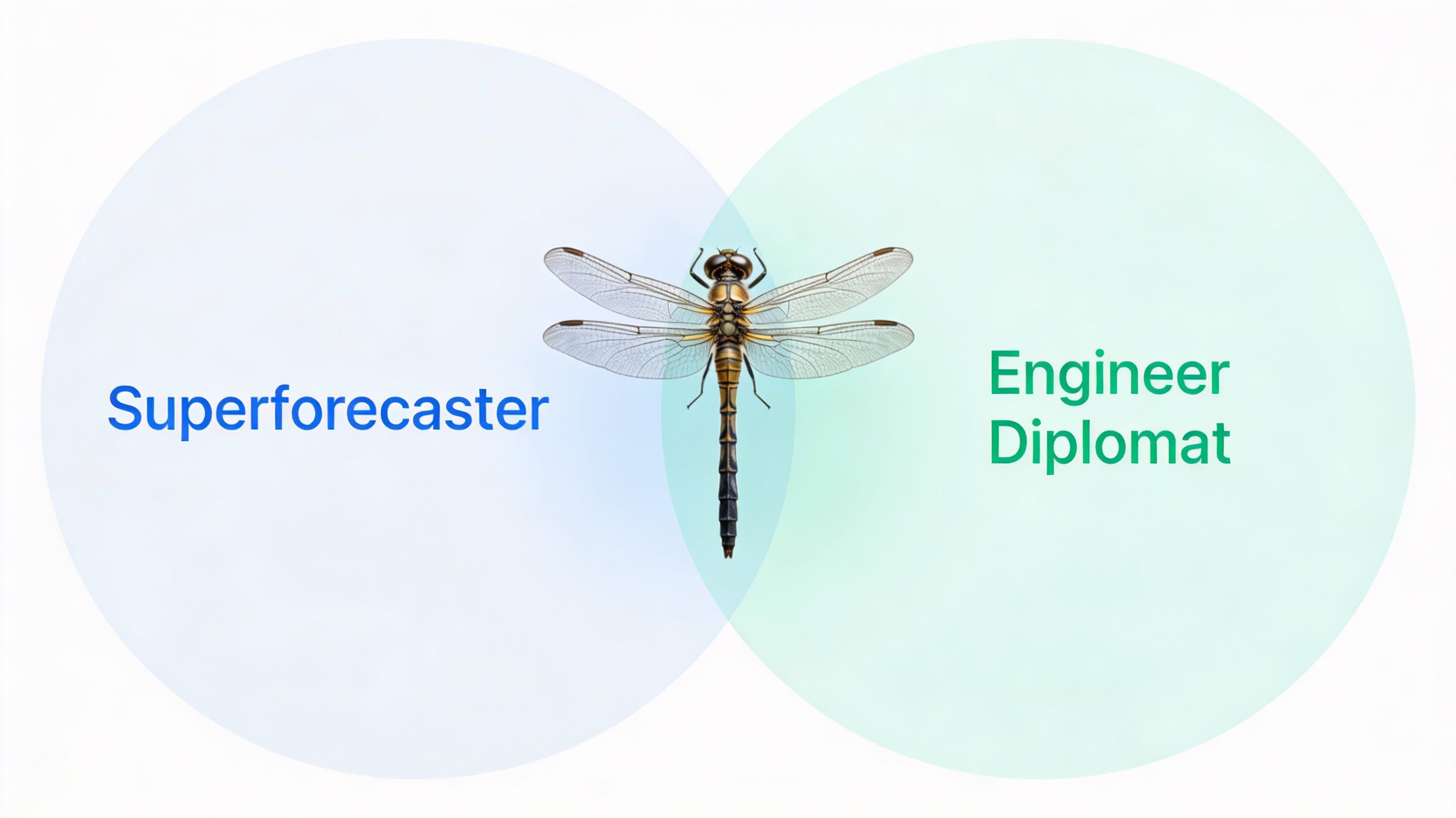
The Dragonfly View: Synthesize Scientific Facts and Social Narratives
The dragonfly-eye metaphor from Superforecasting provides a powerful insight: seeing a problem from multiple, often contrasting perspectives, then stitching them together to form a clearer picture. Just like a dragonfly’s eye, which consists of thousands of lenses, this approach helps reduce blind spots.
For the engineer-diplomat, this means integrating scientific facts (e.g. climate projections or infrastructure data) with social narratives (like local trust dynamics or political will). During the 2025 Texas floods, engineers had accurate models of rainfall and levee stress—but missed the community’s distrust of emergency messaging. The result: low compliance, high harm. A dragonfly-eyed engineer-diplomat would have bridged that gap by combining systems data with social narratives, turning technical analysis into trusted action.
Adopting the Fox Mindset and Be Aware of the Hedgehog Focus
Tetlock contrasts between foxes and hedgehogs. Foxes draw from diverse perspectives and adapt flexibly; hedgehogs stick to one big idea. Superforecasters are foxes but they blend curiosity with rigor.
An engineer-diplomat must think like a fox and act like a hedgehog. Take the case of global AI governance. Politicians may push flashy, unrealistic promises. Engineers may withdraw when ethical debates overshadow feasibility. The engineer-diplomat reframes this divide by using a fox’s breadth to see legal, cultural, and ethical contours, then applying hedgehog-like depth to design realistic frameworks. The goal isn’t to choose between precision and context but to hold both for actionable outcomes. This pattern of thinking allows engineer-diplomat to escape the urgency-actionability trap.
Stay in Perpetual Beta: Learn, Update, Improve
One of the most distinctive habits of superforecasters is their willingness to update frequently, humbly, and in small, reasoned steps. This is what Tetlock calls “perpetual beta”: a commitment to treating beliefs as evolving hypotheses, not static truths.
This approach aligns perfectly with the engineer-diplomat’s need for adaptive planning. For instance, during the COVID-19 crisis, BARDA (Biomedical Advanced Research and Development Authority) officials used a rough back-of-the-envelope estimate to propose that approximately $3.5 billion would be needed to rapidly fund vaccine manufacturing and distribution infrastructure. Their proposal catalyzed Operation Warp Speed and helped expedite US response. The key was agility: making bold moves based on best-available evidence, then adjusting course as new data emerged.
An engineer-diplomat practices principled pragmatism, which mirrors the growth mindset of superforecasters. They use the learning by doing and thinking again approach, treating models as hypotheses in motion using feedback loops to course-correct without losing their principled direction.
Fermi-izing for Strategic Intervention
Superforecasters use “Fermi-izing” to break intractable problems into tractable sub-problems. The Fermi estimation method, often used in the scientific and engineering community, is a helpful starting point for gaining insight into order of magnitude estimation. Strategic impact may come from minimal, well-placed interventions (similar to engineering diplomacy metaphor of where to put the X). For example, In implementing complex goals like Sustainable Development Goal 6.4, the engineer-diplomat may use Fermi-like decomposition to diagnose bottlenecks, such as trust deficits or misaligned incentives, rather than defaulting to expensive infrastructure. By “Fermi-izing” the problem of water scarcity, they can distinguish between physical and institutional scarcity to find the most politically feasible intervention point.
Reframe Creatively: Find the 18th Camel
Sometimes, data and logic alone hit a wall. That’s when creative reframing—seeing a problem from a new lens—becomes the critical move. In Superforecasting, this shows up as escaping the “tip-of-your-nose perspective” and introducing a new variable that unlocks the puzzle.
For decades, Israel and Jordan clashed over their shared water resources in a region of extreme scarcity. A breakthrough came with the Israel–Jordan Peace Treaty of 1994, which contained a detailed annex on water cooperation. Instead of haggling over finite flows, the treaty introduced a creative option to enlarge and optimize the water pie. Israel agreed to provide Jordan with about 75 million cubic meters of water annually – much of it drawn from the Sea of Galilee – and both sides set up a Joint Water Committee for ongoing coordination. Crucially, the treaty reframed water allocation from a zero-sum contest into a flexible, shared arrangement. For example, Jordan was allowed to “store” winter floodwater in Lake Tiberias (when flows are high and would otherwise go unused) and then receive the same amount (20 MCM) transferred back in the summer, when its need is greatest. Israel acted as a seasonal banker of water, ensuring Jordan’s share was available when it was most valuable. This clever timing swap represents a “18th camel” creative option that met both sides’ needs.
The Superforecasting Insights and Ideas in Practice
Superforecasting isn’t about predicting the future perfectly. It’s about thinking and acting critically under uncertainty and ambiguity. It’s a mindset built for complexity: one that replaces prediction with preparation, perfection with iteration, and ideology with learning. For the engineer-diplomat, working at the intersection of science, systems, and human stakes, these five insights offer more than tools; they offer anchors.
See the world through many eyes (Dragonfly View). Think like a fox, act with focused intent (Fox with Depth). Stay in beta mode by always learning, always adjusting. Break big problems down to find the leverage point (Fermi-ize). And when the usual logic fails, don’t just debate harder but reframe the problem and explore the 18th camel. These actionable insights help the engineer-diplomat move from gridlock to foresight, from fragmentation to synthesis, and from complexity to clarity.